
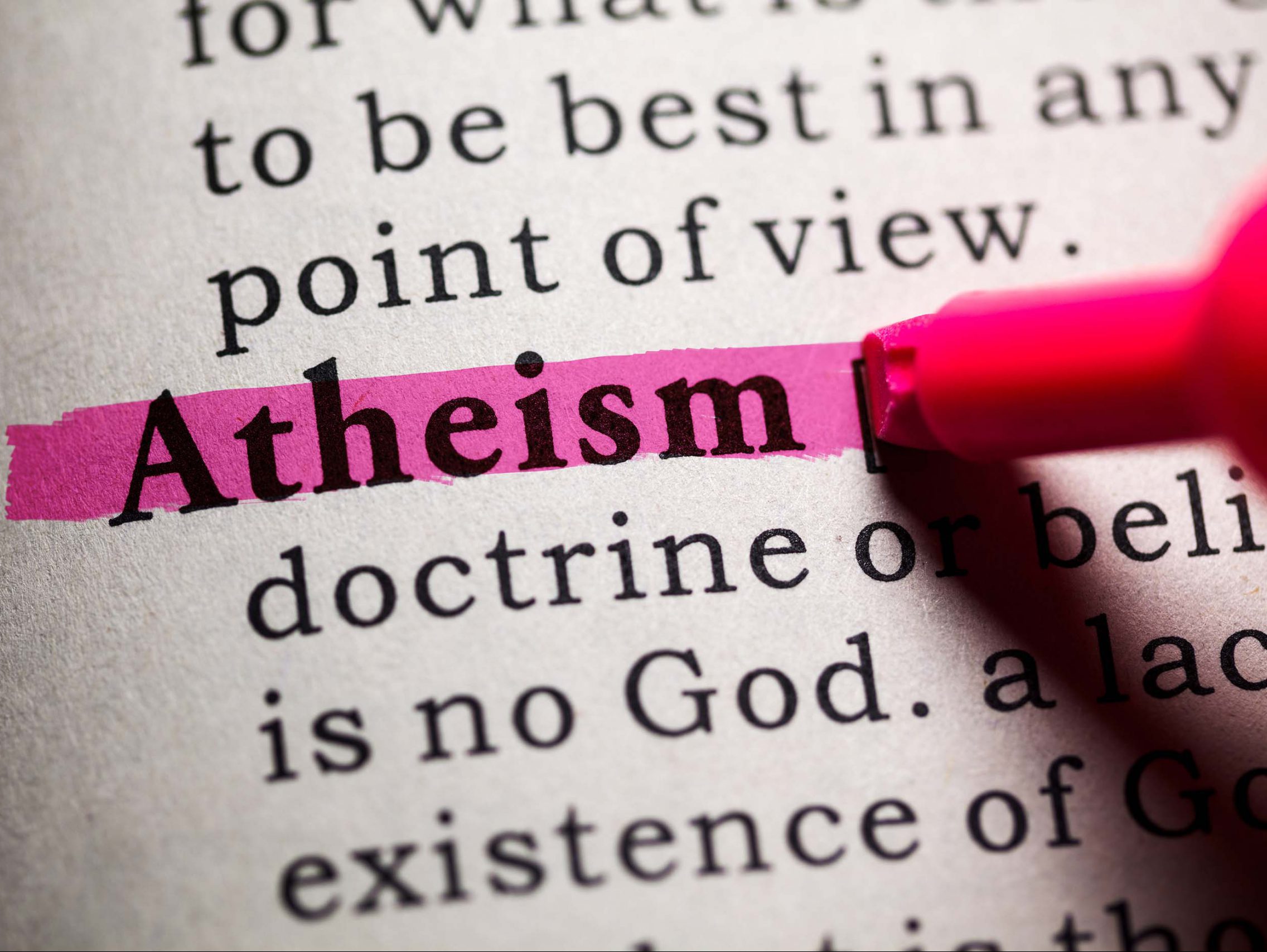
Many people disagree about or misunderstand what “atheism” means. However, we use a very simple definition: An atheist is someone who lacks of belief in gods.
Quick Facts
We define “atheism” as the lack of belief in gods. We believe this is the most inclusive and accurate definition of the term.
Someone who does not believe may not self identify as an atheist and instead choose to use other terms like humanist, freethinker, Bright, secular, or even Cultural Catholic. There’s nothing wrong with those terms but we encourage you to use them alongside “atheist” if you lack a belief in gods.
While almost 30% of Americans are religiously unaffiliated, not all of those people are atheists. According to a 2017 Gallop survey, about 13% of Americans do not believe in gods, but only about 5% self-identify as atheists.
Our View
There have been many competing definitions of the word “atheist” and “atheism” for centuries. The question “What is an atheist?” is also complicated by the differences between definitions and self identity. Many who lack belief in gods do not call themselves atheists, either because of a hesitancy to do so because of negative social stigma associated with the word “atheist” or because of a misunderstanding of the word itself.
American Atheists believes that the most consistent and inclusive definition of “atheist” is someone who lacks a belief in gods. It is not an affirmative belief that there are not gods nor is it a statement about any other beliefs a person holds. It is simply the rejection of the assertion that there are gods.
Is atheism a religion?
Atheism is not a religion nor a belief system. It is the answer to one question: Do you believe in gods?
While there are some religions that are atheistic (certain sects of Buddhism, for example), that does not mean that atheism is a religion.
Despite the fact that atheism is not a religion, atheism is protected by many of the same Constitutional rights that protect religion. That, however, does not mean that atheism is itself a religion, only that our sincerely held (lack of) beliefs are protected in the same way as the religious beliefs of others. Similarly, many “interfaith” groups will include atheists. This, again, does not mean that atheism is a religious belief.
What should I call myself?
Some people choose to use words like agnostic, humanist, secular, bright, freethinker, or any number of other terms to self identify. There is nothing wrong with using those terms to describe yourself. You can be a humanist and an atheist, a freethinker and an atheist, Jewish and an atheist. We encourage everyone to use the word that most people understand: atheist.
Don’t use those other terms to disguise your atheism or to shy away from a word that some think has a negative connotation. There is nothing wrong or shameful about being an atheist! Tens of millions of Americans are atheists.
“Agnostic” isn’t a “weaker” version of being an atheist. It answers a different question. Atheism is about what you believe. Agnosticism is about what you know.
If you call yourself a humanist, a freethinker, a bright, or even a “cultural Catholic” and lack belief in a god, you are an atheist. Don’t shy away from the term. Embrace it!
What about the nonreligious?
In recent surveys, the Pew Research Center has grouped atheists, agnostics, and the “unaffiliated” into one category. The so-called “Nones” now represent almost 30% of all Americans and have grown rapidly over the past decades. However, not all of these religiously unaffiliated Americans are atheists.
Pew separates out atheists from agnostics and the non-religious, but that is primarily a function of self-identification. In 2017, when Gallop asked survey participants if they believe in God, 12% said they did not.
Even more people say that their definition of “god” is simply a unifying force between all people. Or that they aren’t sure what they believe. If you lack an active belief in gods, you are an atheist.
Being an atheist doesn’t mean you’re sure about every theological question, have answers to the way the world was created, or how evolution works. It just means that the assertion that gods exist has left you unconvinced.
Wishing that there was an afterlife, or a creator god, or a specific god doesn’t mean you’re not an atheist. Being an atheist is about what you believe and don’t believe, not about what you wish to be true or would find comforting.
All atheists are different
The only common thread that all atheists share is a lack of belief in gods. Some of the best debates we have are with fellow our atheists. All atheists do not share a common belief system, doctrine or dogma, sacred scripture, or have a single leader. This means atheists often disagree on many issues and ideas.
That having been said, American Atheists advocates for positions and policies shared by many atheists and that reflect our values as an organization.
And while atheists tend to share many of the same values and policy preferences, atheists exist across the political spectrum. We are members of every race, ethnicity, sexual orientation, and gender identity. There are atheists in urban, suburban, and rural communities and in every state of the nation.
Are you an atheist? Great! We hope you’ll join us!
American Atheists is a people-powered organization. We rely on the generosity and support of atheists, humanists, and other nonreligious people all across the United States to protect our rights.