A Term for the Worse: Supreme Court Rulings Again Put Faith Over Freedom
Our summer law clerks analyze the Supreme Court’s just-completed term and the continued consequences of the Christian Nationalist supermajority on the bench.
By
Rhys Guziel, Colleen Mclaughlin
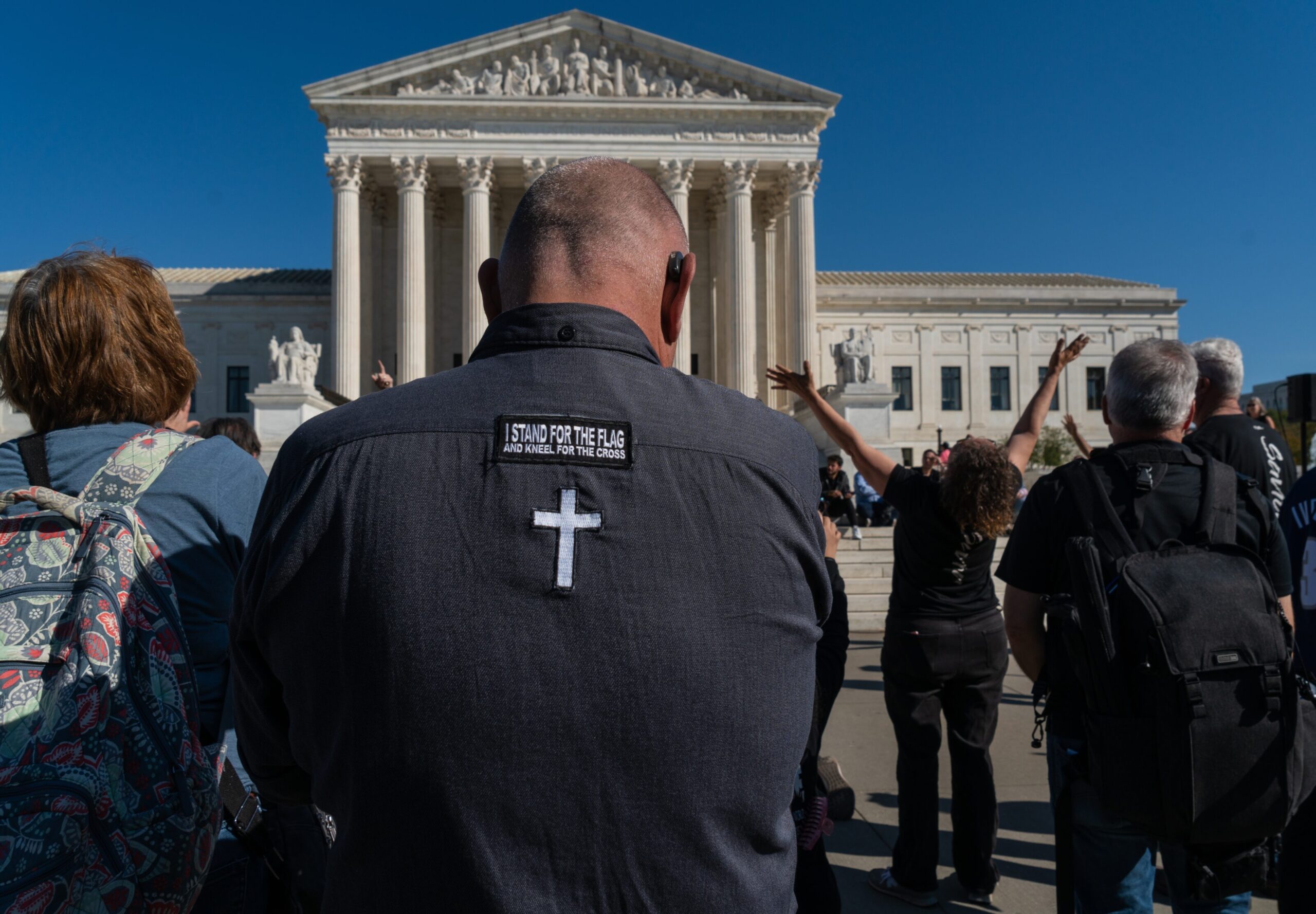
Image by Steve Sanchez Photos / Shutterstock.com
The 2024-25 Supreme Court term may prove to be one of the most consequential in recent history. Three cases could have particularly far-reaching consequences for the separation of religion and government.
The country dodged a bullet in Oklahoma Statewide Charter School Board v. Drummond. Justice Barrett recused herself from the decision due to a conflict of interest. Her absence resulted in an equally divided Court, and the judgment of the Oklahoma Supreme Court was affirmed by a single-page, unsigned decision. Were it not for Barrett and one other, forever anonymous, conservative justice, the wall of separation between church and state would be demolished. For the time being, though, it is still unconstitutional to use public money to fund religious schools.
In Catholic Charities Bureau, Inc. v. State Labor & Industry Review Commission, the Supreme Court addressed whether Wisconsin violated the First Amendment by denying an unemployment tax exemption to the Catholic Charities Bureau (CCB). In a unanimous decision by Justice Sonia Sotomayor, the Court found that Wisconsin’s interpretation violated the First Amendment’s Establishment Clause and sent the case back to the lower courts for further proceedings.
The Court explained that Wisconsin’s rules were based on denominational factors, such as whether the organization tries to convert others or exclusively helps people of the same faith. The CCB contends that these stances are inconsistent with the Catholic faith. The Court found that the State’s asserted interests of ensuring people have unemployment benefits and avoiding too much government involvement with religion were not strong enough to justify its actions. Justice Sotomayor highlighted the importance of maintaining “neutrality between religion and religion” within our constitutional framework.
Overall, this decision supports the principle of government neutrality between religions. However, the lower courts’ application of this decision could have larger effects, as a broad reading could potentially lead to more private actors controlling social services, weakening their accountability and oversight.
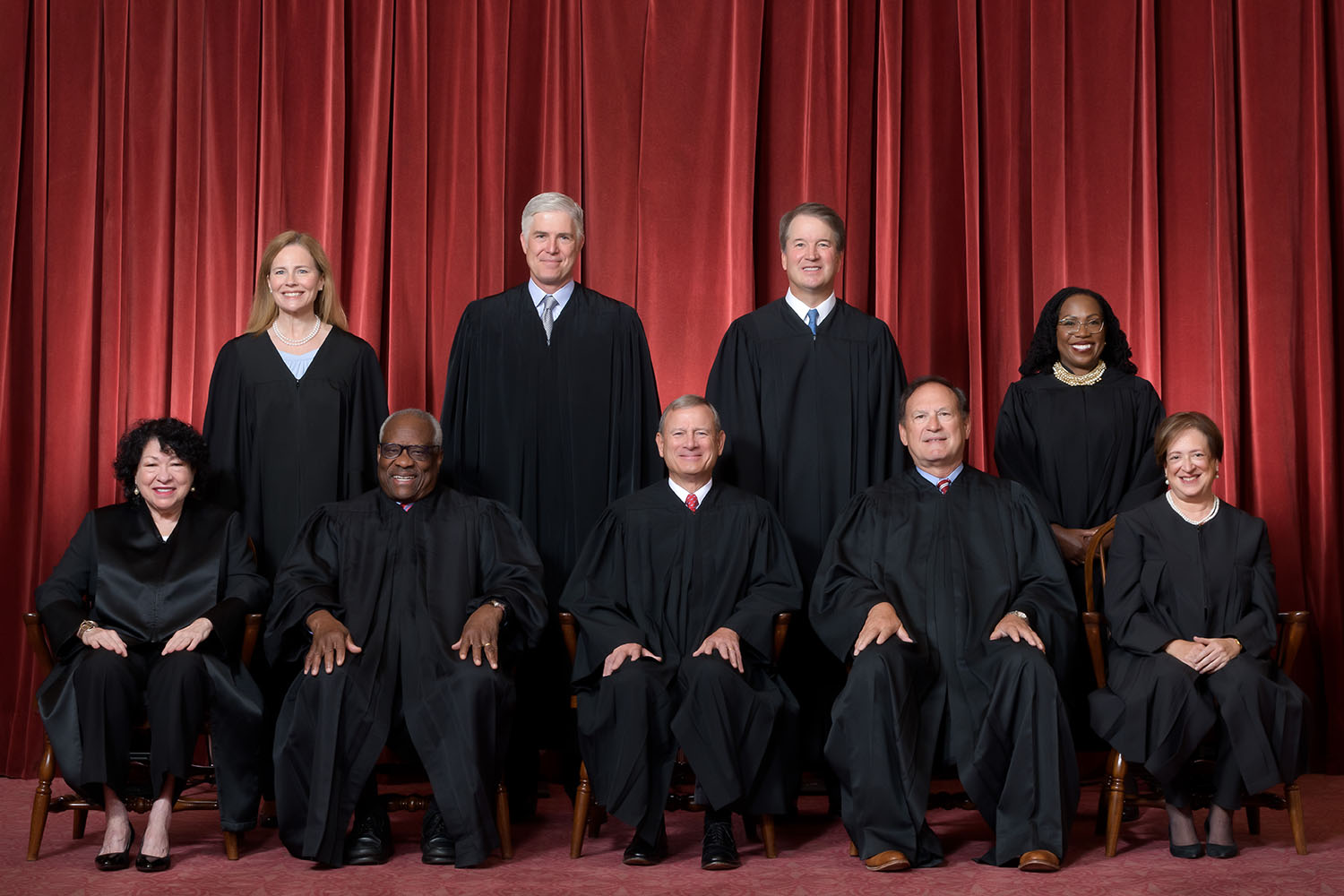
Formal group photograph of the Supreme Court as it was been comprised on June 30, 2022 after Justice Ketanji Brown Jackson joined the Court. Photo by: Fred Schilling, Collection of the Supreme Court of the United States
The Roberts Court returned to partisanship in U.S. v. Skrmetti. Writing for the predictable 6-3 majority, Chief Justice Roberts maintained that Tennessee’s ban on gender-affirming treatments for transgender youth was a permissible “medical use” classification, not a suspect sex-based classification. Even though the “medical use” in question rested on a patient’s sex, Roberts insisted there was no sex discrimination. He repeated this conclusion for twenty-four pages, as if trying to convince himself. By sidestepping intermediate scrutiny, Roberts avoided determining whether the exceedingly creepy justification offered—“encouraging minors to appreciate their sex”—is an important government objective. The “medical use” distinction rests on Geduldig v. Aiello, a case which determined California’s exclusion of pregnancy-related disabilities from insurance coverage did not constitute sex-based discrimination just because the excluded class happens to be made up of members of one sex.
In assessing whether transgender status constitutes a suspect class, Justices Roberts, Alito, and Barrett relied, in part, on immutability. Justice Sotomayor, writing in dissent, forced the conservative bloc to confront a glaring equal protection double standard by analogizing another less-than-immutable characteristic: religion. Sotomayor posed a hypothetical law that prohibits minors from attending religious services inconsistent with their own—or, more precisely, their parents’—faith.
“No one would seriously dispute that such a rule classifies on the basis of religion,” wrote Justice Sotomayor. Such a law would no doubt give some of her benchmates a conniption, but, predictably, neither Justice Roberts nor Alito engaged her hypothetical. As the word “discrimination” has become increasingly common in Free Exercise cases, any individual or entity associated with an institutional religion automatically qualifies for the same level of scrutiny as victims of actual discrimination. This has necessarily come at the expense of LGBTQ+ individuals and the state governments seeking to protect them. This was mostly subtextual, until the Roberts Court put it in writing in Mahmoud v. Taylor.
The majority opinion in Mahmoud held that the parents were entitled to an advance notice and opt-out option when the school uses LGBTQ+-inclusive books, as the introduction of these books unconstitutionally burdened their religious exercise. Writing for the majority, Justice Alito said these books were designed to present values that contradict the parents’ religious convictions (i.e., the acceptance and existence of same-sex marriage and gender nonconformance). The books and the denial of advance notice and opt-outs made it more difficult for the parents to control their children’s views on gender identity and sexual orientation. The majority based their decision on Wisconsin v. Yoder, a case intended to protect Amish communities from laws that threatened the survival of their way of life. Absurdly, Alito claims that children encountering different types of families in elementary storybooks was just as dangerous. According to the majority, the mere possibility of children being shown different or new ideas in public school is a violation of religious liberty. These parents are now relieved from the inconceivable burden of letting their children learn that not everyone lives, or thinks, the same way they do.
Sotomayor’s dissent thoroughly unpacked the majority’s manufactured logic. Like Kennedy and Dobbs before it, the ruling in Mahmoud upended decades of precedent, only to leave pseudo-originalist vagaries like “history and tradition” in its place. Sotomayor engaged with what she, generously, dubbed the “very real threat” test and found that it lacked clear guidance and meaningful limits. The potential applications, she noted, stretch far beyond LGBTQ+-inclusive reading material. She cited cases in which courts have heard religious objections to a host of once-uncontroversial topics like women’s rights, patriotism, and interfaith marriage. In the same vein, a religious parent could object to the presence of a lesbian teacher as contrary to their religious convictions, and the school would have to capitulate.
American Atheists raised the same argument in our amicus brief. Sotomayor also maintained that even if such a test is rooted in Yoder, it would be a difficult one to pass. A criminal statute compelling an isolationist religious group to assimilate is, objectively, a much greater threat to their free exercise than the presence of LGBTQ+-inclusive materials in a public school curriculum. But the majority interpreted “very real threat” to mean “any challenge, real or imagined.”
One positive throughline in this troubling series of cases is Justice Sotomayor’s commitment to maintaining not just the separation of church and state, but the Constitution itself. Atheists can take some comfort in the fact that at least one justice is leading the charge against Christian Nationalism in the Supreme Court.
Colleen Mclaughlin is studying law at The University of the District of Columbia—David A. Clarke School of Law. Rhys Guziel is studying law at DePaul University Law School in Chicago, Illinois. Both were law clerks with American Atheists for the Summer 2025 term.