
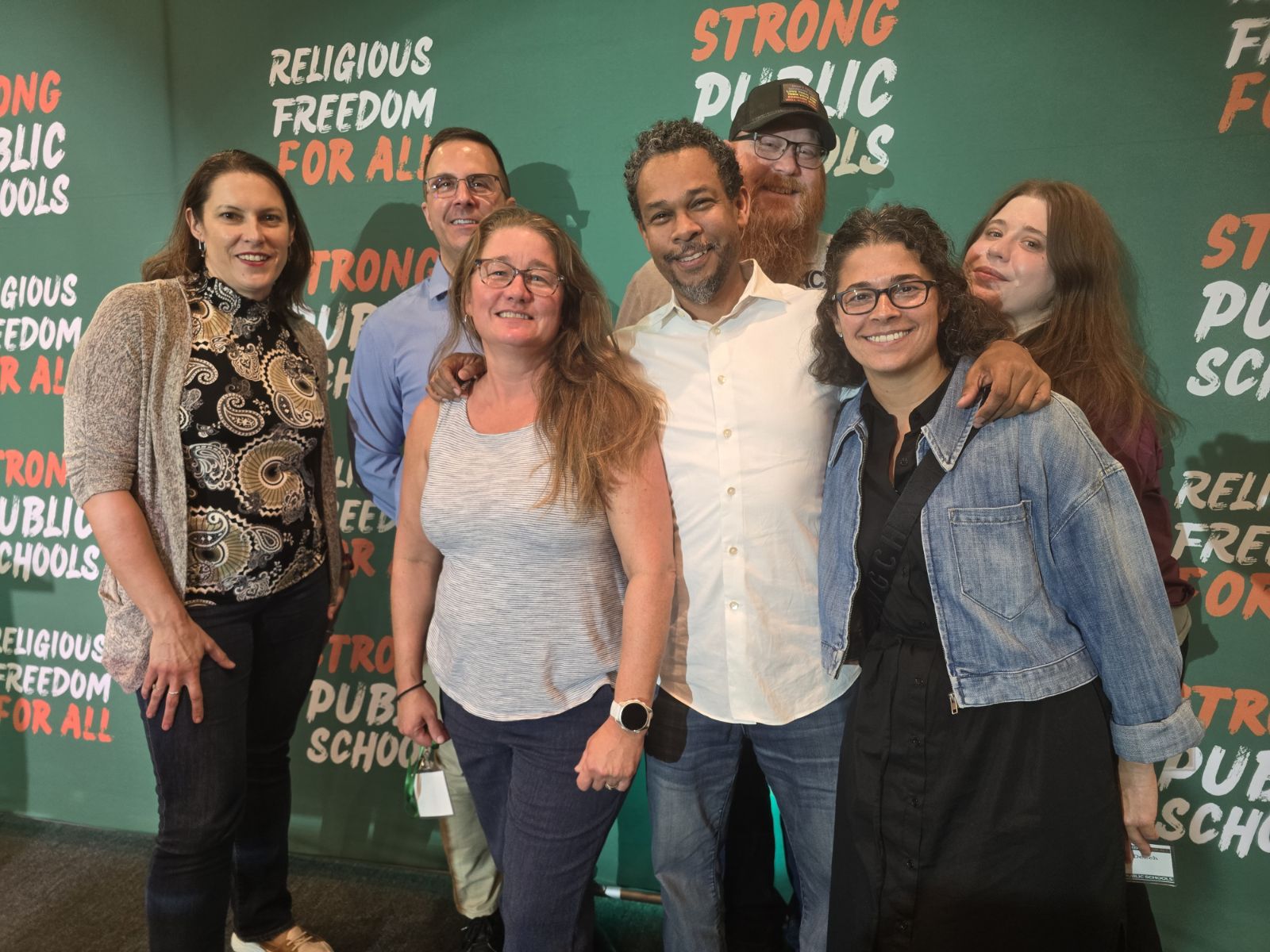
In September, advocates from across the country came together in Dallas for the National Religious Freedom in Public Schools Summit to continue our fight against the insertion of Christian Nationalism into our public schools.
When Texas lawmakers decided untrained chaplains could take the place of school counselors, a handful of groups who agreed students deserve counselors—not missionaries—started working together to push back. What began in 2023 as a response to a single bad law has since become one of the strongest interfaith and secular coalitions defending real religious freedom in public education.
The idea was simple: If state lawmakers wouldn’t protect the boundaries between religion and government, then local communities would. Together, we organized clergy letters, sign-on statements, and press events. We mobilized Texans to attend school board meetings and urge their districts not to adopt chaplain policies. It worked.
And it didn’t stop there. When Florida passed a nearly identical bill, a similar network successfully replicated the Texas strategy and proved that coordinated, values-based advocacy can stop the spread of religious intrusion into public schools. By the time we convened in Dallas, the coalition had become a national force of atheists, Baptists, Muslims, Jews, Hindus, Sikhs, and others, united in defense of students’ right to learn free from religious coercion.
The summit was hosted by Interfaith Alliance and more than a dozen national partners, including American Atheists. It featured local organizers and activists, too, and was attended by over 150 advocates from 22 states. The agenda covered the full range of education challenges we’re seeing across the country.
For American Atheists, it was an opportunity to contribute and connect. Secular voices, like that of Wil Jeudy, our Texas State Director, were loud and proud within rooms that were truly representative of the diversity of the religious freedom movement.
In one session, “Lessons from Texas for the Rest of the Country,” speakers from Texas Impact, Temple Beth-El, and the Texas Freedom Network discussed how cultural change starts in communities, not at state capitols.
That’s already our approach at American Atheists. We know when regular people show up to school board meetings, write letters to the editor, and talk to their neighbors about what’s happening, it makes a real difference.
Other sessions examined the legal, historical, and moral dimensions of church-state separation. There were discussions about court trends, the connection between school vouchers and religious favoritism, and how these same forces show up in curriculum fights and mandated religious displays that blur the line between teaching religion and preaching it.
The summit made clear how coordinated the push to inject religion into public education has become— and how determined our movement is to push back. In breakout sessions, participants strategized by topic and geography, shared resources, compared challenges, and planned next steps. The conversations were as urgent as they were optimistic.
For me, the best part was engaging with advocates from different backgrounds. It’s one thing to exchange emails; it’s another to share a meal. Working remotely can feel lonely, but coming together helps you see not only how connected you are but to how many!
What is community if not connections like these, a sense of shared purpose that isn’t purely academic or on an agenda, but is deeply human?
Everyone there not only understood but genuinely cared about what’s at stake for students. And nearly everyone agreed we have to stop playing defense all the time. No longer can we simply react to bad bills and bad actors. We need to tell our own stories about what religious freedom really means and the good that comes from inclusive and secular schools.
Our fight for public schools isn’t about belief versus nonbelief. It’s about fairness and the right to live freely and without coercion. American Atheists is proud to partner with allies of faith who recognize the vital perspective we bring and share our commitment to church-state separation.
And from Dallas to Duluth, we’re going to keep doing what we do best: strengthening networks, supporting local activism, and making sure secular voices are at the table. Because we won’t win this fight alone. But together? We just might.